
Open Electricity Dispatch — December 2025

Each month, we round up the most interesting shifts in the grid – new records, infrastructure updates, and other signals of change in Australia’s electricity system.

What caught our eye this month:
☀️ Renewables hit a new monthly record
⚡ Solar generation reaches another high
🔋 Battery discharge jumps 41%
🌬️ Wind projects return to FID
Closing out the year, December typically brings rising electricity demand alongside particularly strong solar generation. While solar output often continues to increase into January, December frequently sets new highs as summer conditions take hold.
In December 2025, however, consumption across the NEM fell slightly compared with December 2024, likely reflecting cooler weather. This stands out against a backdrop of growing electricity use, with total NEM consumption rising around 1.8% across the year.
Notable Records
The NEM recorded its highest ever monthly renewable generation in December, reaching 9,507 GWh – almost 12% higher than the previous record set in December 2024. December has now been the peak month for renewable generation in six of the past seven years, driven by strong solar conditions and the steady expansion of solar capacity throughout the year.
This growth has been particularly visible in Queensland. Much of Australia’s wind capacity is concentrated in the southern states, but three new wind facilities have commenced operations in Queensland since October 2024, representing more than 60% of the state’s total wind capacity. While some of this capacity is still commissioning, these additions – combined with stronger wind conditions than in 2024 – resulted in more than two and a half times the wind generation recorded in December 2024.
Solar generation in the NEM reached a new monthly record in December 2025, with 5,701 GWh produced – 9% higher than the previous record of 5,214 GWh set in December 2024.
South Australia continues to lead the NEM in the share of generation coming from solar. Overall growth in solar generation there was modest, increasing by just 1% compared with December 2024. However, several shorter-interval records were set during the month.
At 1:30 pm on 18 December, solar output in South Australia reached an instantaneous peak of 2,524 MW. To put this into perspective, the state’s average electricity consumption across December was around 1,742 MW – meaning the solar peak alone was roughly 70% higher than typical demand.
The continued expansion of rooftop solar, combined with relatively stable demand, has increased curtailment in the state. Almost 20% of South Australia’s potential solar generation was spilled during December – close to double the electricity produced by gas generation over the same period. This dynamic can be seen on 18 December, where total potential solar generation exceeded 2,500 MW, with curtailment occurring until system conditions allowed utility-scale solar output to increase.
South Australia solar generation — 18 Dec 2025
Batteries discharged 248 GWh across the NEM in December, 41% higher than the November total. The monthly discharge record has now been broken in ten of the past twelve months, with only the shorter month of February and September failing to exceed the previous record.
December also provided an early glimpse of the impact of longer-duration batteries entering the system. Most batteries currently operating in the NEM have a storage duration of around two hours or less. The Limondale BESS in south-west NSW recently commenced operations but has not yet contributed significantly to generation totals.
However, two four-hour batteries played a notable role during the month. The Eraring BESS, which began operating in March, recorded its highest discharge yet in December at 20.9 GWh – far exceeding its previous monthly high of just under 3.5 GWh in July. The Melbourne Renewable Energy Hub (MREH), which comprises three battery units, includes one four-hour system (MREH3). After commencing in October, MREH3 discharged 22.3 GWh during December.
These longer-duration batteries were among the largest contributors to the monthly discharge record and show a distinct operating pattern, continuing to discharge later into the evening than the two-hour systems that currently dominate the market.
Daily profile for Victorian batteries across December
Facilities Update
Wind farms reach FID
Across much of 2025 there was a prolonged period in which no wind projects reached final investment decision (FID), a slowdown widely noted across the sector. That changed in December, when several projects reached financial close in quick succession.
Waddi Wind Farm in Western Australia, Delburn Wind Farm in Victoria, and Carmody’s Hill Wind Farm in South Australia each reached FID within the space of a week. Together these projects represent around 580 MW of new wind capacity.
Further projects may follow soon. The Palmer Wind Farm in South Australia is reported to be “very close to financial close” and is targeting construction to begin by mid-2026. The project already has an offtake agreement with AGL, suggesting the gap before the next wave of projects reaches FID may be shorter than the lull seen earlier in the year.
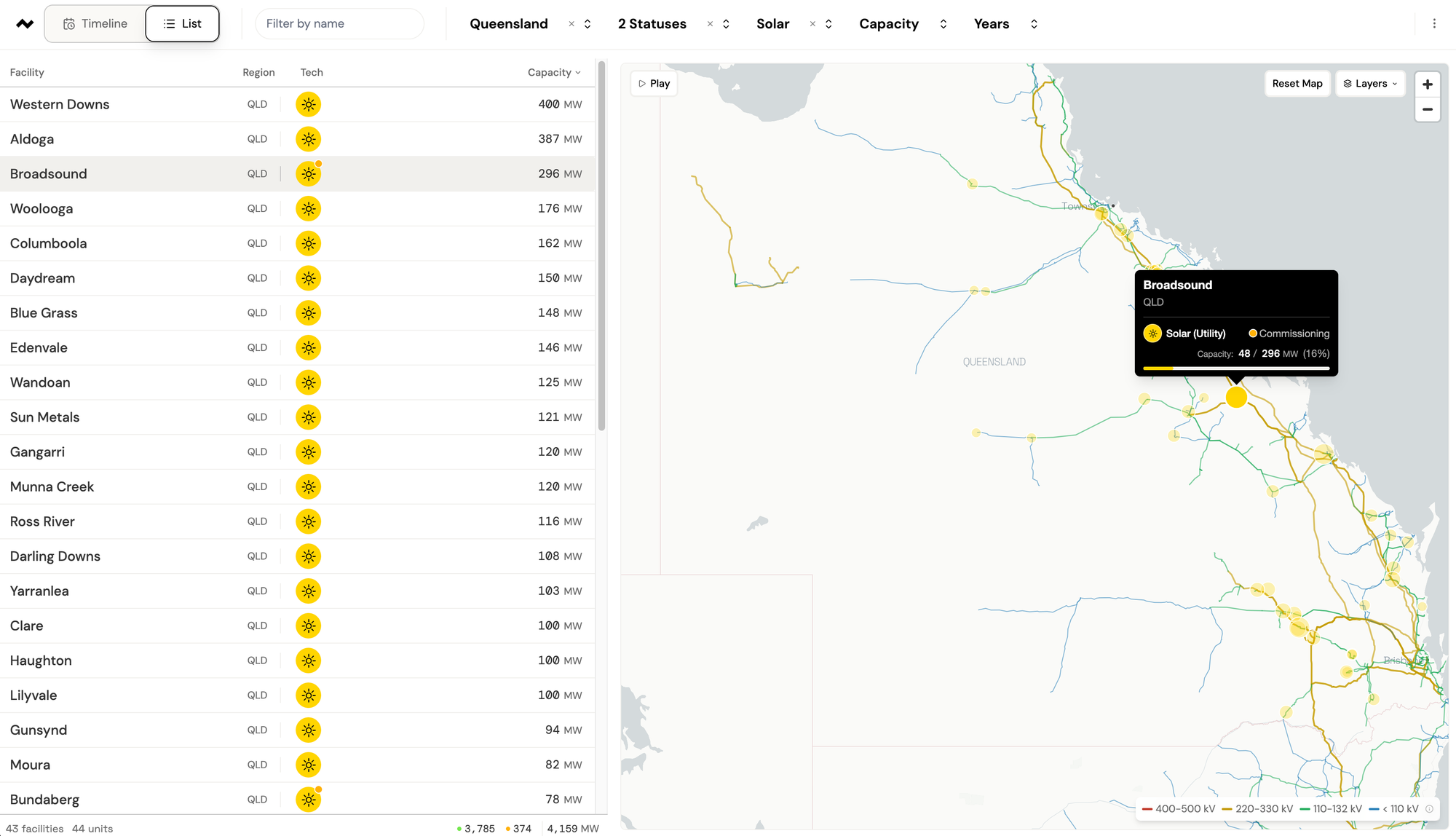
Broadsound starts generating
The Broadsound Solar Farm began generating on 24 December. At 368 MW, it is the third-largest solar farm in Queensland and the eighth largest in the NEM.
The project was developed by Spanish energy company Iberdrola, marking its largest solar development in Australia to date. Iberdrola has previously developed the Avonlie Solar Farm in New South Wales and the Port Augusta Renewable Energy Hub in South Australia.
The company is also considering adding a 180 MW / 360 MWh battery at the Broadsound site, though the project has not yet reached a final investment decision.
SA batteries
Construction has begun on the Goyder North Battery in South Australia. The 226 MW / 866 MWh system will have significantly greater storage capacity than any battery currently operating in the state. For comparison, the Blyth Battery (400 MWh) is currently the largest operating facility, although the Summerfield BESS under construction will be larger again at 960 MWh.
The project is being developed by Neoen, which has built several major Australian battery projects, including the Hornsdale Power Reserve. Goyder North will also be the first project to deploy Tesla’s new Megablock system – a larger battery module launched in September that aims to reduce installation time and cost.
Meanwhile, the Bungama BESS, which began construction in October 2024, has now commenced operations. The 150 MW / 300 MWh facility is notable for being one of the first batteries in Australia financed on a fully merchant basis – meaning it secured commercial lending without long-term offtake agreements and may operate largely in the spot market.South Australia already has the highest concentration of battery activity in the NEM. With new projects progressing, the state now has around 3.2 GWh of storage under construction, compared with about 1.8 GWh currently operating.
___
See all records and the latest facilities updates at Open Electricity.
Get monthly and quarterly analysis, plus updates on new features and platform developments - direct to your inbox.