
Open Electricity Dispatch — January 2026

Each month, we round up the most interesting shifts in the grid – new records, infrastructure updates, and other signals of change in Australia’s electricity system.

What caught our eye this month:
🌬️ Strong wind lifts renewables
🛢️ QLD gas hits 19-year low
⚡ SA sets new monthly RE record
🔋 NSW battery output hits new high
January, the heart of summer, brings both high demand and strong solar generation. After a cool December, several states experienced extreme heat events in January, setting new instantaneous demand records and lifting total consumption almost 4% above December levels.
Renewables saw strong growth in Q4 2025 and January maintained the strength, increasing on the December total, due primarily to stronger wind.
While coal generation did rise compared to December – particularly in Victoria, where higher demand required additional dispatch. However, at a national level, coal generation was down about 5% compared to January 2025.
This decline occurred despite a substantial increase in consumption. South Australia, in particular, recorded a 9% year-on-year jump in demand. For context, total NEM consumption increased by approximately 1.8% between 2024 and 2025.
Notable Records
Queensland recorded its lowest monthly gas generation since 2006, producing just 198 GWh in January.
In recent dispatches, we’ve noted the decline in output from Queensland’s peaking open-cycle gas plants, partly reflecting growing competition from batteries, which are increasingly capturing the short-duration price spikes that once sustained peakers.
This month, however, we also saw a substantial decline in the more efficient closed-cycle plants.
Average closed cycle gas generation in Queensland across January
Queensland has historically exhibited the most stable gas profile in the NEM, with relatively low variance across hours and days compared to other states. That stability makes this drop more significant. The explanation goes beyond competition for batteries: wind generation in Queensland more than doubled compared to January 2025, materially displacing gas across the month.
South Australia recorded its highest ever monthly renewable generation, more than 11% above the previous record set just one month earlier. December saw a broadly similar generation mix, though compared with earlier periods of high renewable output there are some notable shifts.
Rooftop solar continues to grow as new capacity is added, while wind generation has also strengthened compared with previous summers. This reflects the steady expansion of the state’s wind fleet, including the commencement of the Goyder South wind farm in 2024.
Utility-scale solar tells a more complex story. Despite the growth in overall renewable generation, utility solar output in summer months has declined in recent years. Curtailment data suggests this is not due to weaker solar conditions, but rather increasing volumes of spilled electricity as generation exceeds the system’s ability to absorb it.
Cumulative energy from SA utility solar
This comes despite high electricity consumption and the rapid growth of battery storage. During the month, 48 GWh of electricity was used to charge South Australia’s batteries, yet 69 GWh of solar generation was curtailed – with additional curtailment affecting wind.
Battery capacity is expanding quickly. Around 2 GWh has now commenced operations in the state (some of it very recently and therefore contributing little so far), with almost 3 GWh under construction and more projects approaching final investment decision.
This expansion will allow more renewable generation to be stored and used. However, it is worth noting that curtailment was minimal on some of the days when demand and prices were highest, suggesting the issue is not simply a lack of storage capacity.
For further analysis of curtailment across 2025, see Dan Lee’s article in WattClarity.
Batteries in NSW discharged a total of 51 GWh during the month, surpassing the previous record of 43 GWh by 18%.
In earlier dispatches we noted the outsized influence of the state’s two largest batteries – the Eraring battery and the Waratah Super Battery – even while still commissioning. The Eraring battery has now completed commissioning, with Origin announcing full operations on 7 January.
Although several other large batteries in NSW are currently commissioning or under construction, few have yet reached full output or made a substantial contribution to overall discharge. Eraring is also a four-hour battery – only the second of that duration in the NEM to complete commissioning – highlighting the growing shift toward longer-duration storage.
As a result, the impact of the Eraring battery is particularly visible when compared with the state’s existing battery fleet.
Average battery activity in NSW across January
Bidirectional units only (positive = discharge, negative = charge)
Facilities Update
Orana 4-hour battery begins operation
With the Eraring battery now fully commissioned, another four-hour battery has begun operating in NSW. The Orana BESS is a 415 MW / 1,660 MWh facility developed by Akaysha Energy, one of Australia’s leading battery developers.
In terms of storage capacity, Orana is now the third-largest battery in the NEM, behind Origin’s Eraring battery and Akaysha’s Waratah Super Battery.
NSW has historically lagged behind Queensland, Victoria, South Australia and Western Australia in battery deployment. Despite having the largest electricity consumption in the NEM, the state saw less battery energy discharged across 2025 than any of the other mainland regions.
Recent additions suggest that this is beginning to change. With several large batteries now entering operation, NSW is positioned to see a substantial increase in the role of storage in the year ahead.
Colocated batteries enter the NEM
Two further batteries have entered the NEM this month, both co-located with existing generation assets.
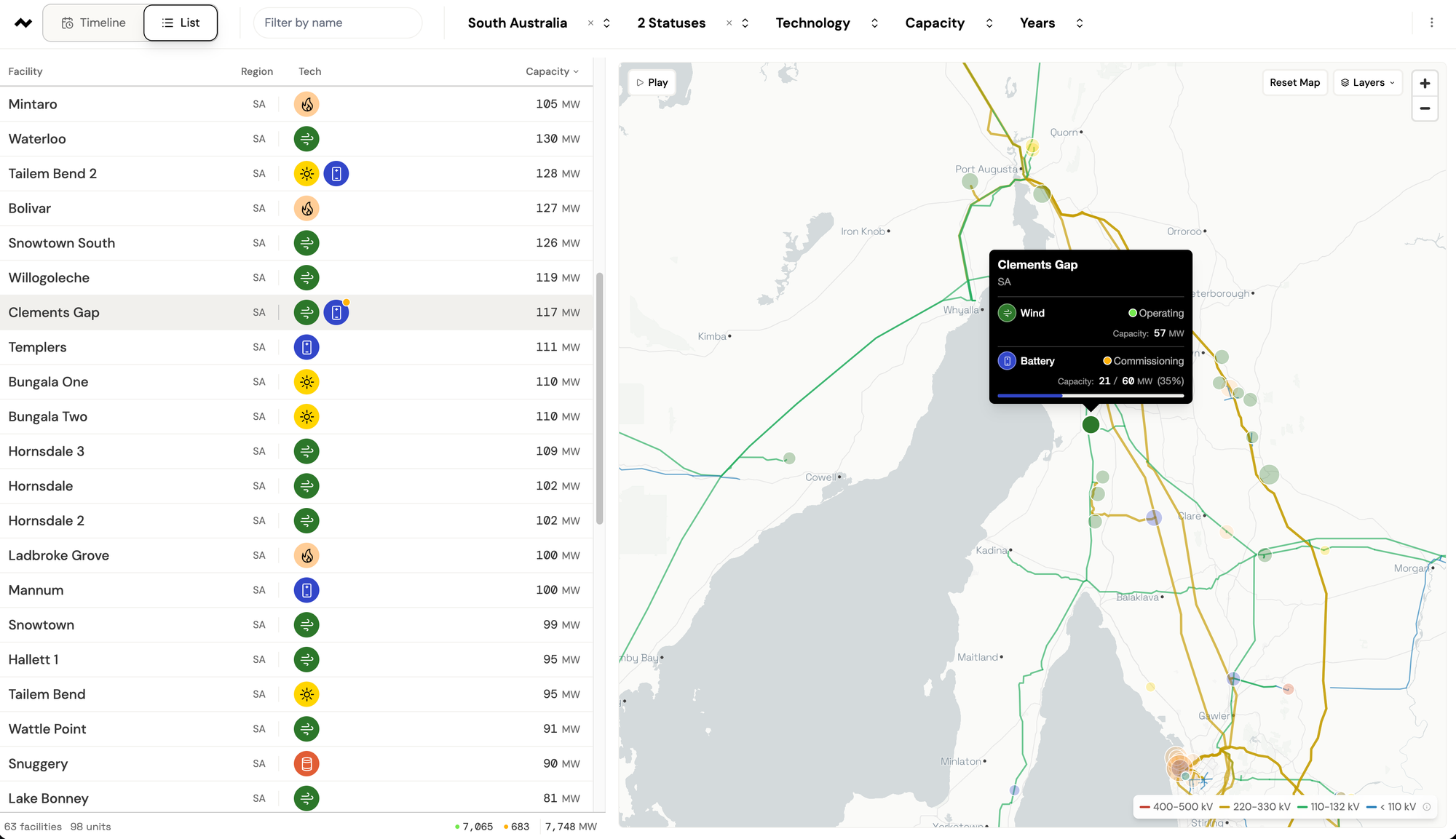
At the Clements Gap Wind Farm in South Australia, a 60 MW / 120 MWh battery has commenced alongside the 57 MW wind facility. In New South Wales, the Quorn Park battery – a 19 MW / 40 MWh unit – has begun operating next to a new solar farm with a registered capacity of 96 MW.
While these projects combine storage with generation at the same site, the battery units have separate grid connections. This differs from integrated hybrid facilities such as the Cunderdin solar farm in Western Australia and a number of committed hybrid projects in the NEM.
Windy Victoria adds to fleet
On 29 January the first generation was recorded from the Golden Plains West Wind Farm. The project forms part of the Golden Plains complex, which will become the largest wind farm in Australia once fully operational.
Golden Plains East, the first stage of the project, has a registered capacity of 758 MW. The western extension will add a further 557 MW, although so far only the first unit has begun generating.
Victoria already has the largest wind fleet in the NEM, and the addition of Golden Plains lifts total installed wind capacity in the state to just over 6 GW – more than double that of any other mainland state.
Further development is also underway. Construction began on the 205 MW Delburn Wind Farm on 28 January 2026 after the project was acquired by the state-owned SEC Victoria. Australia’s east coast has experienced an extended period without new wind farms entering operation, although several projects reached final investment decision late in 2025. Delburn is currently the only wind farm under construction in Victoria.
South Australia’s battery build-out continues
Construction has begun on the Goyder North battery in South Australia. The 226 MW / 866 MWh project will have greater storage capacity than any battery currently operating in the state. The largest operating facility is currently the 400 MWh Blyth battery, although the Summerfield BESS – also under construction – will be larger again at 960 MWh.
The Goyder North battery is being developed by Neoen, which has built several major battery projects in Australia, including the Hornsdale Power Reserve. The project will also be the first to deploy Tesla’s new Megablock system. Announced in September, the larger battery unit is designed to reduce installation time and cost. As construction progresses, it will provide an early indication of how deployment timelines compare with previous battery projects.
Another South Australian battery has also entered operation. The Bungama BESS, a 150 MW / 300 MWh facility, began generating after construction commenced in October 2024.
Bungama is notable for its financing structure. According to Westpac, it was the first Australian battery financed by commercial lenders on a fully merchant basis – meaning the project secured debt financing without long-term offtake contracts with a retailer or other buyer.South Australia already has the highest level of battery activity in the NEM. With Bungama now operational and several projects under construction, the state has around 3.2 GWh of storage capacity being built – well above the roughly 1.8 GWh currently operating.
___
See all records and the latest facilities updates at Open Electricity.
Get monthly and quarterly analysis, plus updates on new features and platform developments - direct to your inbox.