
Open Electricity Dispatch — March 2026

Each month, we round up the most interesting shifts in the grid – new records, infrastructure updates, and other signals of change in Australia’s electricity system.
What caught our eye this month:
🌊 QLD breaks 24-year hydro record
🌿 Bioenergy hits unexpected high
💨 Windy WA breaks quarterly record
🔥 Boyne smelter generators near construction
Editor’s note: You may have noticed that the Dispatch newsletter fell a little behind over the summer months. We’ve caught up now, and the missing editions can be found on the Open Electricity website.
As we enter the second quarter of the year, the electricity system approaches its most challenging period to manage. Summer sees the hottest days and thus the highest demand, though increased solar generation now allows the system to meet summer peaks more comfortably.
On the other hand, autumn sees solar decline paired with the NEM's weakest period of wind generation, albeit with lower overall consumption. This dynamic has been most acutely felt in Victoria, with variable renewable generation declining by over 12% from the February total.
Notable Records
Queensland generated a total of 6.9 GWh from hydro on 12 March. The state hasn’t added any hydro generation since 2000 when it introduced a 7 MW non-scheduled facility, in which generation is not counted in our generation numbers. Looking back further, the last facility added that we have generation data for was in 1984, well before the establishment of the NEM.
Despite this, Queensland has seen the highest yearly hydro generation in each of the last five years. The daily record however had remained at 6.8 GWh since 2000, until it was broken last month.
Queensland only has three facilities – two conventional hydro plants (Barron Gorge and Kareeya) and a pumped hydro plant (Wivenhoe). The increased generation of recent years has come almost entirely from Wivenhoe, with some year-to-year variation from the other stations.
Queensland hydro generation by power station
The Wivenhoe increase likely reflects its ownership transfer from CS Energy to CleanCo in 2019. CleanCo was introduced with the goal of reducing the market power of CS Energy and Stanwell – which collectively owned about 70% of generation – as assets such as Wivenhoe may have been under-utilised to keep prices high for other assets.
Wattclarity has some good analysis on the changing behavior of assets taken on by CleanCo. Kidston, another CleanCo pumped hydro facility, is expected to come online in the near future.
NSW has seen the highest daily bioenergy generation on record, with 1,159 GWh on 15 March 2026. Bioenergy does not typically feature in our commentary due to its low contribution, at just 0.1% of total generation in the NEM across 2025. However, NSW has seen several bioenergy records in recent times.
Most of the biomass generation in the NEM is bagasse, a byproduct of sugarcane production, and NSW has only two bioenergy facilities with generation data, Condong and Broadwater. This makes biomass production heavily seasonal. Typically, bioenergy generation follows the national cane crushing cycle, but this pattern diverged in recent months when the Broadwater power station increased generation considerably in November 2025.
National weekly cane crush vs biomass generation
Crush data from Australian Sugar Manufacturers
Source: sugarmanufacturers.org
Biomass generators occasionally submit negative generation values to AEMO, suggesting behind-the-meter load that the generators may power – adding complexity to understanding the facilities' actual generation.
3. Highest wind generation over a quarter
WA has seen greater wind generation in Q1 2026 than any previous quarter. The previous record stood at 1070 GWh in Q1 2022, and was surpassed on the 26th of March.
No wind farms have commenced operation in the state since the Flat Rocks Wind Farm came online in November 2023, indicating the record reflects strong wind conditions rather than increased capacity. WA is known for particularly strong wind conditions, and while the NEM typically sees strongest wind generation in winter and spring, WA consistently sees its highest generation in summer.
Wind farm capacity factors — Q1 2026
Only showing wind farms > 100MW. Registered capacities are used for capacity factor calculation
About 10% of available wind generation in the NEM was curtailed in Q1, and some facilities – such as Golden Plains West – are still in commissioning.
Facilities Update
Bundaberg Solar Farm commences
The Bundaberg Solar Farm commenced on 5 March, having started construction in June 2024. While Queensland has seen a series of solar farms commence across 2026, Bundaberg is expected to be the last for some time, with only one solar farm – Wandoan – under construction and expected to come online in 2027. Bundaberg has a registered capacity of 101MW.
Mortlake BESS begins operations
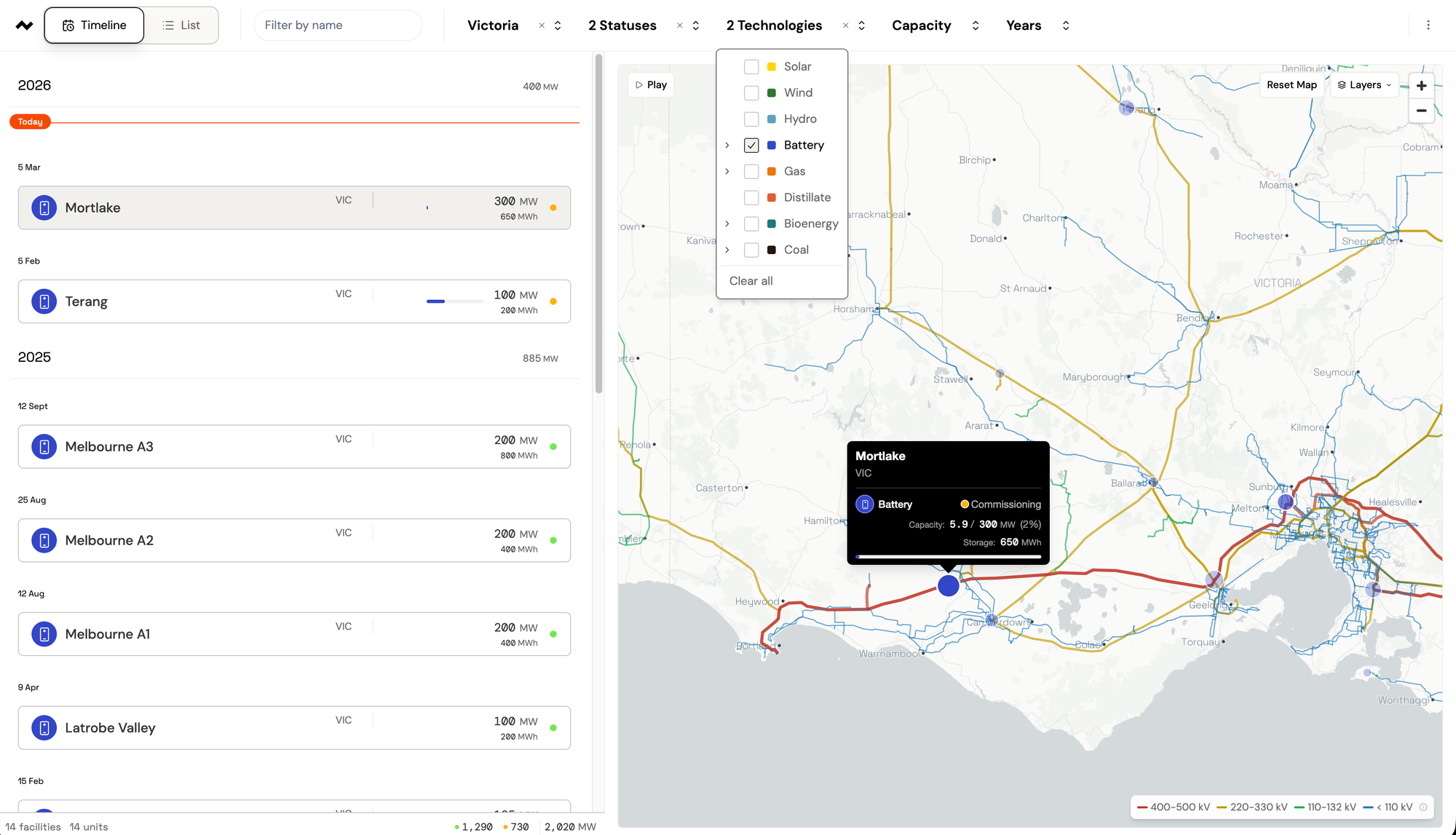
The Mortlake BESS commenced operations in Victoria on 5 March. The 300 MW / 650 MWh facility is the second largest battery in the state by storage capacity. Victoria added 885 MW of capacity in 2025, with a further 890 MW expected online in 2026, including the Mornington BESS and Pine Lodge facilities.
Edify projects near construction
Edify has selected DT Infrastructure for the engineering, procurement and construction of two Queensland projects. The Smoky Creek and Guthrie’s Gap project consists of a 600MW solar farm and a 600 MW/2400 MWh battery, now with an offtake agreement with the Rio Tinto Boyne aluminium smelter.
The Ganymirra and Majors Creek project consists of a 300 MW solar farm and a 300 MW / 1,200 MWh battery. Both projects are DC-coupled hybrids, sharing a single grid connection to increase battery efficiency.
Queensland currently has the most battery generation of any NEM region in absolute terms, with several large projects committed including Supernode 2, Supernode 3, Stanwell, and Western Downs – each with over a gigawatt-hour of storage.
___
See all records and the latest facilities updates at Open Electricity.
Get monthly and quarterly analysis, plus updates on new features and platform developments - direct to your inbox.