
Open Electricity Dispatch — October 2025

Each month, we round up the most interesting shifts in the grid – new records, infrastructure updates, and other signals of change in Australia’s electricity system.

What caught our eye this month:
☀️ Renewables pass fossil generation
⛏️ Coal drops like a… rock
🔋 Batteries continue the charge
🦘 Collie gets another battery
🕗 Limondale 8-hour battery commences
October often delivers renewable highs. Four of the last five Octobers set new renewable generation totals for the NEM. Milder weather also tends to suppress demand – typically ~4% below the annual average – and together these factors push coal and gas slightly lower than September’s already subdued levels.
Renewable records at this time of year are largely driven by an increase in solar generation in Victoria. Solar generation in the southern state sees much larger variation from summer to winter than its northern counterparts – partially due to geography, but also its ratio of rooftop solar to utility solar.
October also saw the sustained growth of batteries, with more large facilities entering the commissioning process.
View all records for the month of October.
Here’s your monthly dispatch from Open Electricity:
Notable Records:
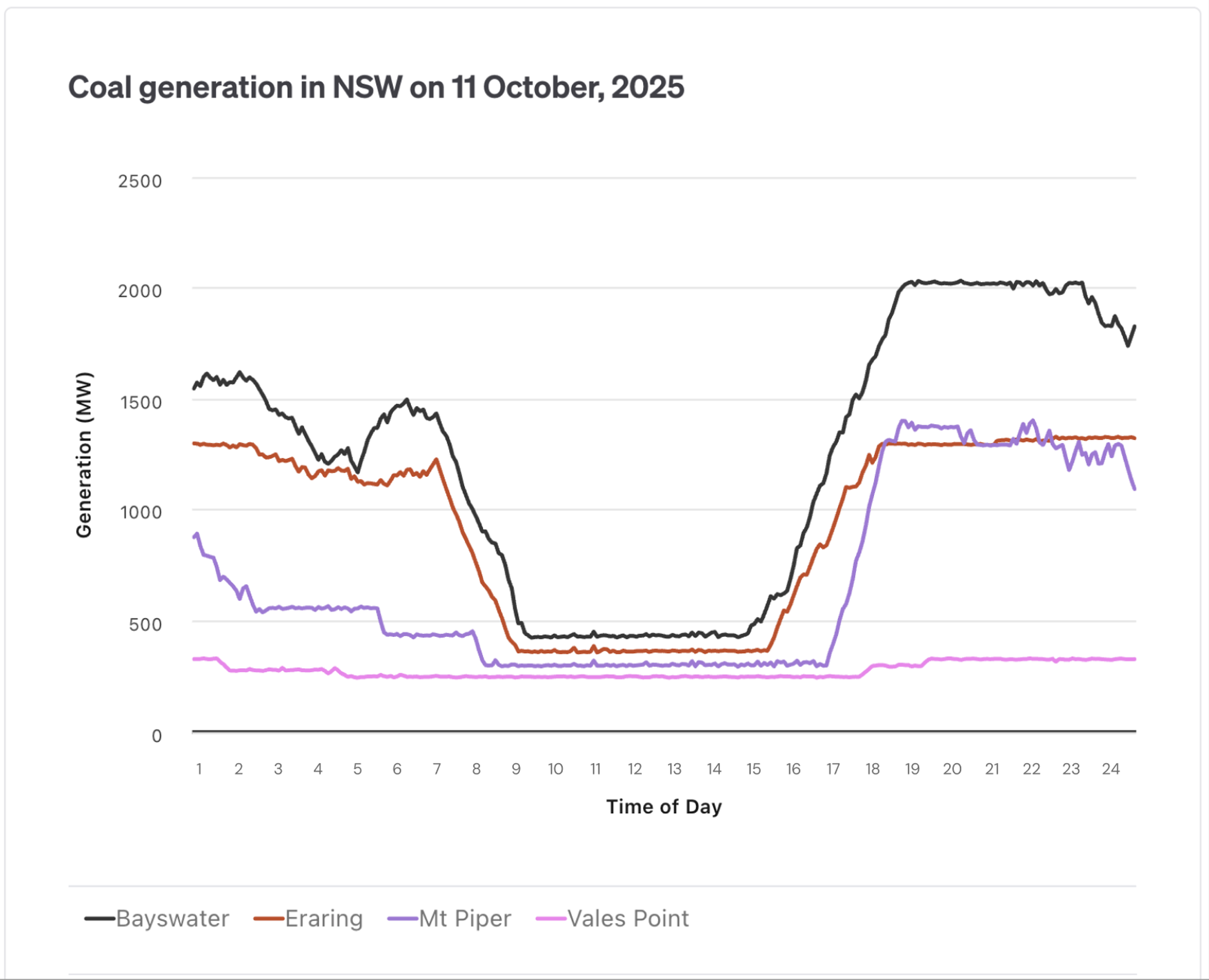
At 11:50AM on 11 October, NSW recorded its lowest ever coal generation: 1,331MW. This drop helped push the NEM to its own lowest coal output on record – 5,810MW, almost 4% lower than the previous low set on 20 October 2024.
NSW has the highest registered coal capacity in the NEM – 8,240MW across 4 facilities and 12 units. At the time of the record low:
- Five units were completely offline
- Six units were hovering at their minimum stable output
- Bayswater Unit 2 – which has recently captured some particular attention – had reduced its generation to zero. It ramped up again seven hours later – an example of two-shifting, used to avoid uneconomic operation during very low prices. One of the units has.
Several states reached new daily battery discharge milestones in October. Victoria and NSW exceeded 3GWh discharged in a single day for the first time, while South Australia passed 2GWh.
SA’s growth can be attributed to the Templers BESS. Although it first generated in May this year, it contributed very little until last month. Templers is now the state’s second largest battery, and supplied more energy than any other SA battery on October 23, the day the record was broken.
Other states are showing similar uplift as new projects enter commissioning. The Melbourne Renewable Energy Hub, which began operating in August, has quickly become one of Victoria’s most influential batteries. Its second unit came online in September, and generated 670MWh on October 29, the third highest daily contribution of any Victorian battery on the day.
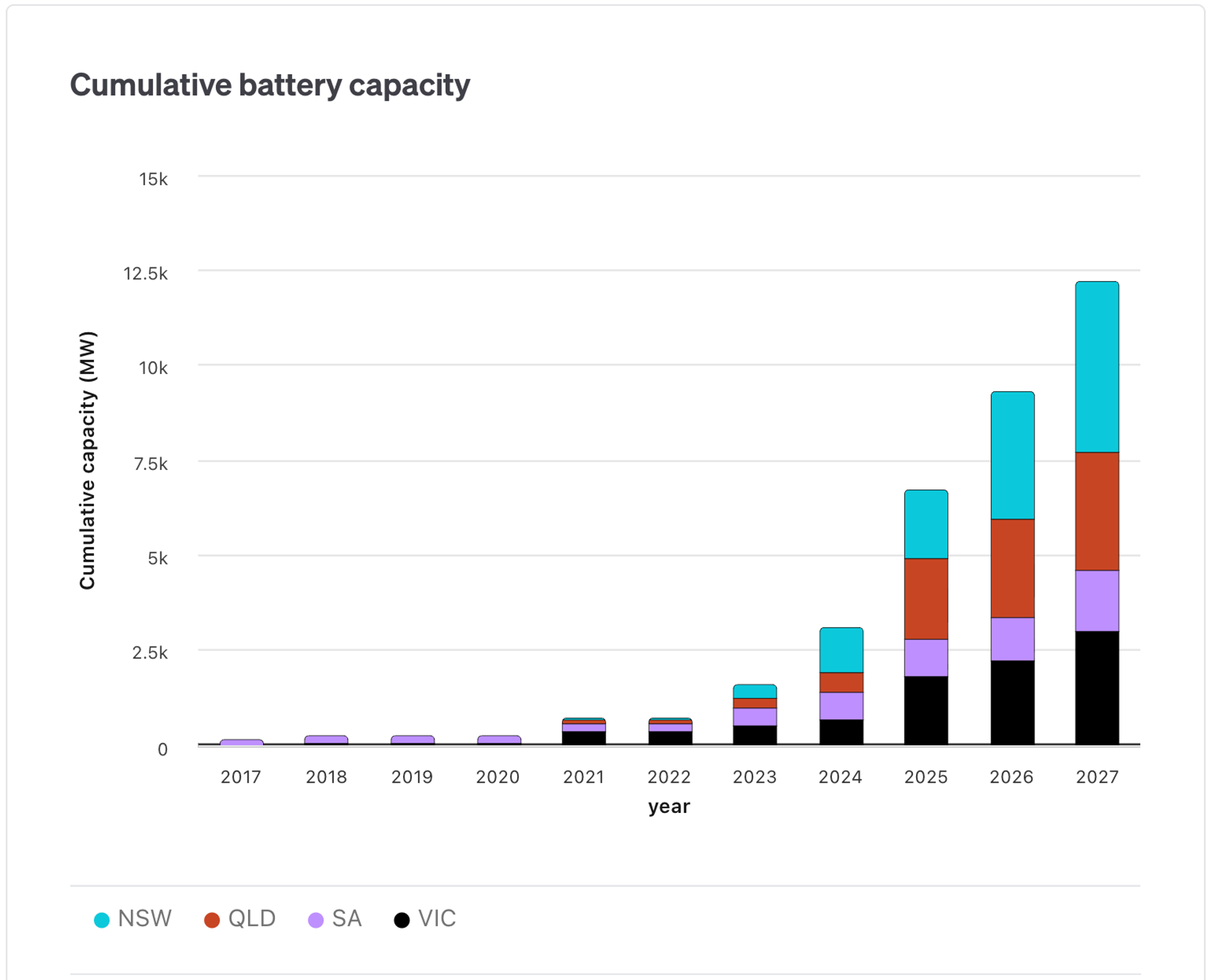
NSW has seen particularly fast growth.While SA and VIC have operated grid-scale batteries since 2017-18, NSW’s first (Wallgrove BESS) didn’t arrive until 2021. Today, NSW has 11 batteries. The ongoing commissioning of a further two large batteries – the Waratah Super Battery and Eraring – explain much of the variation in our battery charging and discharging levels. On 17 October, the day of the state’s record high, Waratah contributed over 75% of all discharged energy.
We can of course expect many more battery records in the coming months, with more capacity either in construction or at final investment decision than the entire fleet of operating facilities.
The NEM recorded its highest monthly renewable generation on record in October – and for the first time ever, renewables exceeded fossil generation across an entire month. October delivered 9,089GWh of renewable energy – a figure that is likely to be surpassed in December (the month of highest renewable generation in four of the last five years).
Queensland recorded 13% more renewable generation than in any previous month. Most of this increase came from new wind capacity recently added, though the state also recorded its highest rooftop solar output.
Facilities Update
Collie BESS
Australia’s largest battery by storage has begun operation in Western Australia. Synergy’s Collie BESS is a 500MW/2000MWh facility, surpassing the 1,770MWh Eraring BESS in terms of total energy (although that battery is still being expanded). It joins Neoen’s four-hour batteries already operating in the Collie region.
WA records more discharged battery energy than any other state, even in absolute terms, despite having lower consumption than Victoria, New South Wales and Queensland. The impact of the new Collie battery on the grid so far has been marginal, though we can expect a considerable increase as it commissions, with the facility comprising over a third of the already substantial battery storage and power in the state.
Limondale BESS
RWE’s new battery facility has achieved a significant milestone, becoming the first 8-hour battery to commence operation on the grid. The project was supported through a Long-Term Energy Service Agreement (LTESA) – an options-style contract that gives projects access to minimum cashflows when prices are low, reducing investor risk and bringing forward new renewable and storage investment.
Supernode BESS
The first node of the Supernode BESS has begun generating in Queensland. Like many of our new batteries, the developer, Quinbrook, is a new entrant in the NEM. The first stage, at 260MW/545MWh, is one of the largest in the state. Quinbrook will expand the facility, with stage 2 under construction, stage 3 contracted to Stanwell (the Queensland Government owned energy company), and stage four in advanced development.
The first three stages are expected to be a combined 780MW/3,096MWh, almost equal to the total amount of storage currently operating elsewhere in the state. The size of stage four does not appear to be public, though it is known to be an eight hour battery.
Gnarwarre BESS commences construction
Fotowatio Renewable Ventures (FRV) commenced construction of the Gnarwarre BESS in Victoria on 29 October. The 250MW/500MWh battery is now one of seven batteries currently under construction in the state, which includes another FRV project, the Tarang BESS, which is expected to commence operations in mid-2026.
___
See all records and the latest facilities updates at Open Electricity.
If you’ve subscribed to OpenNEM or Open Electricity email updates in the past, we highly recommend signing up again (in footer). We’re rebuilding our list from scratch, and we don’t want you to miss out.